Creating your own language is a crazy idea!
Business would say this is inefficient, impractical, time-consuming, and expensive. But for us, experiences like this are simply too boring to skip!
For one of our species — the extinct silicon civilization of Bazhi — our team invented a language from scratch. It was incredibly exciting, and we decided to share how it all came together.
Background
This article is a description of the process and our approach to creating a new, unique writing system for the supposedly extinct silicon civilization of Bazhi in the world of Arcarion.
The team whose work I will try to describe has experience in video game development, but none of us had invented a writing system before, and none of us are professors of linguistics. Therefore, the terminology used in this article is simplified and may not be entirely appropriate for professionals. =)
However, our specialists truly put their hearts into this task and worked on it every day!
Daria — Author (Telegram @immortalponi), (Telegram channel), (Litnet)
Kseniya — Artist (Telegram @KT_Artist), (ArtStation)
Thank you!
Introduction
Spoiler: this article is insanely dense!!
This language — or rather, writing system — will be used as a decorative element in locations, creating atmosphere. In addition, these writings will be used to tell stories, legends, and warnings to the player. We could have followed business wisdom and, for the sake of efficiency and cost savings, simply reused something ready-made and existing. But that would be so boring! Tasks like this are exactly what brought our enthusiastic team together. They are a challenge for us — one that helps us grow once we overcome it. Any difficult task requires thought and planning. And any planning requires deep research into the essence of the question, so that we can gain competence and immerse ourselves in the magic of communication.
That was the starting point...
Research
We could have gone to a library or consulted professors, but that would have been slow, expensive, and would not have given us all the answers in one place. We could have just started googling, but that would have taken us more than half a year too. So we decided to use Perplexity.ai to search for information (it provides source links and minimal hallucinations). Even so, we manually checked every query and every answer, following the provided source links and evaluating the quality of the source, the context, and the adequacy of the response.
When creating something new, artificial intelligence can become not a helper, but a saboteur! It can lead you away from a brilliant idea or even misinform you entirely. So if you do use models to help, use them only for information gathering — and always verify everything.
The work took a little over a month of daily effort.
I studied a brief history of more than 350 languages and around 200 writing systems. Yes, yes, we understand that this is just a drop in the ocean of 7,000+ languages. But our time was limited, so we made a selection: 50% were the most widespread languages and scripts, and 50% were the rarest and dead languages.
The sample included whistles, grunts, sign languages, and coding systems. The brain struggled...
The task was to compare extremes, understand the reasons behind the success of some and the death of others, and examine the cause-and-effect relationship between the construction of sounds and writing. How do they reflect culture, change it, or themselves change under the pressure of other cultures? Was there a dependence on geographic region and on adapting sound and writing to the literal environment where the speakers lived?
In addition, we studied a huge number of fictional languages used in games, films, books, and so on.
Based on conlang communities and catalogues, we can speak of hundreds of constructed languages — it seems there are 500+ — of which dozens gained significant popularity in pop culture. We studied about 200 more of them ourselves.
We were interested in other people’s approaches and in how these languages gained fame or faded into obscurity.
Interestingly, among the best known are Quenya and Sindarin (Tolkien), Klingon (Star Trek), Na’vi (Avatar), Dothraki and High Valyrian (Game of Thrones), and even Simlish (The Sims).
Research Findings
From the results, the same forces play a key role for both language and writing: power, utility, prestige, inheritance, and usability (adaptability/changeability):
- ▪A dominant language gives better chances for work, education, and status.
- ▪Pressure from the state: bans or restrictions on using the language in schools, courts, the military, media, forced assimilation, colonial policy.
- ▪Urbanization and migration: moving to cities, mixed marriages, preference for a “common” language in the family so children have an easier social and economic path.
- ▪Low prestige: the language is seen as “rural” or “backward,” so speakers stop passing it on to their children.
- ▪Physical disappearance of speakers: wars, epidemics, genocide, environmental catastrophes.
- ▪Flexibility: when new objects, states, or events appear, the language’s structure may not be ready to provide new words that accurately convey meaning, leading to borrowing from other languages.
However, for writing systems, I’d also like to emphasize additional reasons for survival or death:
- ▪A writing system lives as long as it is tied to a living political or religious elite and state institutions (administration, cult, education); and as long as there is systematic training of scribes/teachers and real-world use (documents, books, religion, media).
- ▪A writing system dies when the civilization or elite that used it disappears or changes radically (Egyptian hieroglyphs, Mayan script, cuneiform); when it is displaced by a more universal or more “prestigious” alphabet (Greek, Latin, Cyrillic, Arabic script); or when it acquires a negative prestige or a religious/political stigma. The construct’s functionality is limited and does not scale or adapt to new times.
For us, this was crucial, because in the end we abandoned the spoken language and focused on the writing system. Cutting corners? Not at all! That was built into the lore =)
Means of Communication
The next step was to understand what this language/script is for our silicon civilization Bazhi. How would they use it? Why? For what purpose?
Spoiler alert: writing is not their primary means of exchanging information. And there is no spoken language at all.
The silicon civilization exchanges information like electronics in a unified network. Literally through electrons between one another and through architecture, which serves not only as protection but also as storage and transmission of information over long distances — much like our wires.
This civilization simultaneously has both a collective mind, thanks to constant synchronization of information, and personal opinion, as an individual sentient being. The longer a being does not communicate with the unified stream of information, the more independent it becomes and the more its opinion differs from others.
This is also why this species tries to weave its networks across all sectors of the planet Proxima Centauri b (where the main gameplay of several of our games takes place), so as not to lose the shared network with each individual of the species.
The conductors constantly emit electromagnetic waves, which they literally feel and thus “see.” This principle determined the design of the symbols. They are mathematically measured, consisting of lines and dots. No curls and no symbols sticking together. Otherwise, during wave interference, these waves would literally drown each other out, and it would be much harder for them to read/see the symbols.
Important!
The writings are not a way for them to communicate with one another. They are an attempt to transmit information to other species. This civilization has elevated information into a cult and seeks to preserve, accumulate, and pass it on by any means. And understanding that other species are diverse and unlike them, they chose not to transmit sounds or colors, but entire images.
Each symbol is an image. And different species may interpret sentences in their own way, depending on their level of development. This makes the language universal and flexible. However, it is difficult to synchronize because of differing readings. It will be hard to transmit precise information.
In addition, our Bazhi civilization is conservative: each generation exists for centuries, and emotional coloring is practically absent due to a pseudo-collective shared mind. What need is there for emotions if everyone is synchronized?
At the same time, they have a mathematical way of thinking. This determined the approach to our next stage.
Symbol Structure
In a personal conversation, when people ask me how we handled this stage, I almost feel embarrassed =)
It was a week before New Year’s and three days before my son was born. At the same time, I had already been running a fever for a week, swinging from 35.0°C to 39.3°C. And at some point in the evening I just sat down and, like a zombie, started drawing, adding tools to the symbol-construction system.
Of course, our visual exposure and all the research we had done beforehand played a role. But honestly, I don’t remember exactly how it all happened. Here’s what we ended up with...
A symbol/image is considered to be a rectangular structure with its own zones for specific semantic and contextual meanings. In essence, ideologically, everything is assembled like a construction set within a single system, where the root — the meaning — sits in the center. Around it is optional functionality that changes/switches the root’s meaning or adds context/nuance.
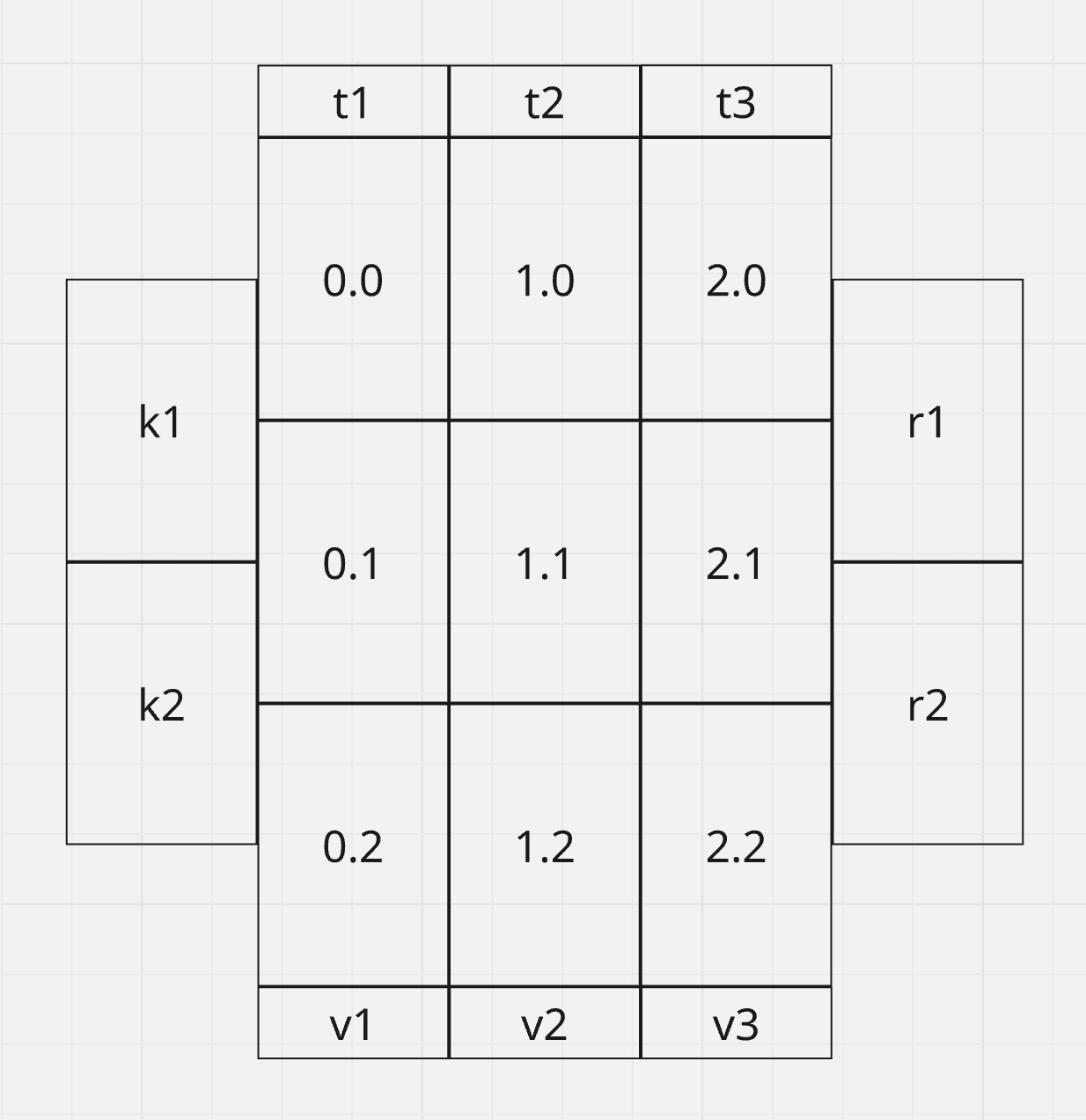
In the image, we see the following set of tools: t — time, k — keys, r — radicals, v — aspects.
And in the center — the root.
I’d be lying if I said this is how it came into being right away in my head.
At first, I took the obvious path: 1 symbol = 1 meaning. And when I tried to scale the roots, it turned out that although there are thousands of possible ways to write this symbol within a 3x3 grid, the number is still limited, and at some point we would hit a ceiling.
Imagining tens of thousands of similar symbols that differ by time, place, and so on, I realized that for ease of orientation, we needed to “pull out” time and give it separate blocks. That added combinatorics — great! But it still wasn’t enough.
The next stage was to “pull out” three more blocks for aspects, which would add context to the process taking place. In effect, they work as an additional element to time. That allowed me to describe more correctly complex sentences like “We live so that others may live.” “Live” and “may live” — agree, those meanings are extremely important both in form and in duration.
However, later I ran a small test to try simulating translation not from our language into Bazhi, but the other way around. And there still wasn’t enough context. How would the reader know what exactly is being discussed? Is this an action as a process or an event as a completed fact? Is it abstraction, or is it a matter of substance? Something specific, or just a generalization about everything?
That was how the radicals were born. It seems even in our own languages and writing systems, context is extremely important. But given the technical and logical nature of Bazhi civilization, I tried to think like something engineering-oriented, describing the existence of the world around them in their own language. So in the early iterations I used strictly the terms that might seem important to them, key to communication, and I systematized them into a complex structure.
Still, one question remained open: would that context be enough? How would we know that what is written is an unshakable law, or a request, or a recommendation — or even a mathematical formula? And “division” can mean “2 divided by 2,” or “society divided into the right and the wrong.” That was how the keys were born.
But during yet another test pass of applying the writing, I noticed that in completely different sentences, with different images in each symbol, we were repeating the same key over and over, which eventually became irritating. So I added the ability to use a key for the entire sentence, while still keeping the option to add keys to each individual symbol.
All this gave the symbol constructor such combinatorial power that now it is possible to create more than half a million variants of a symbol’s writing style — actually, much more than that. =)
Let’s look at it in more detail below...
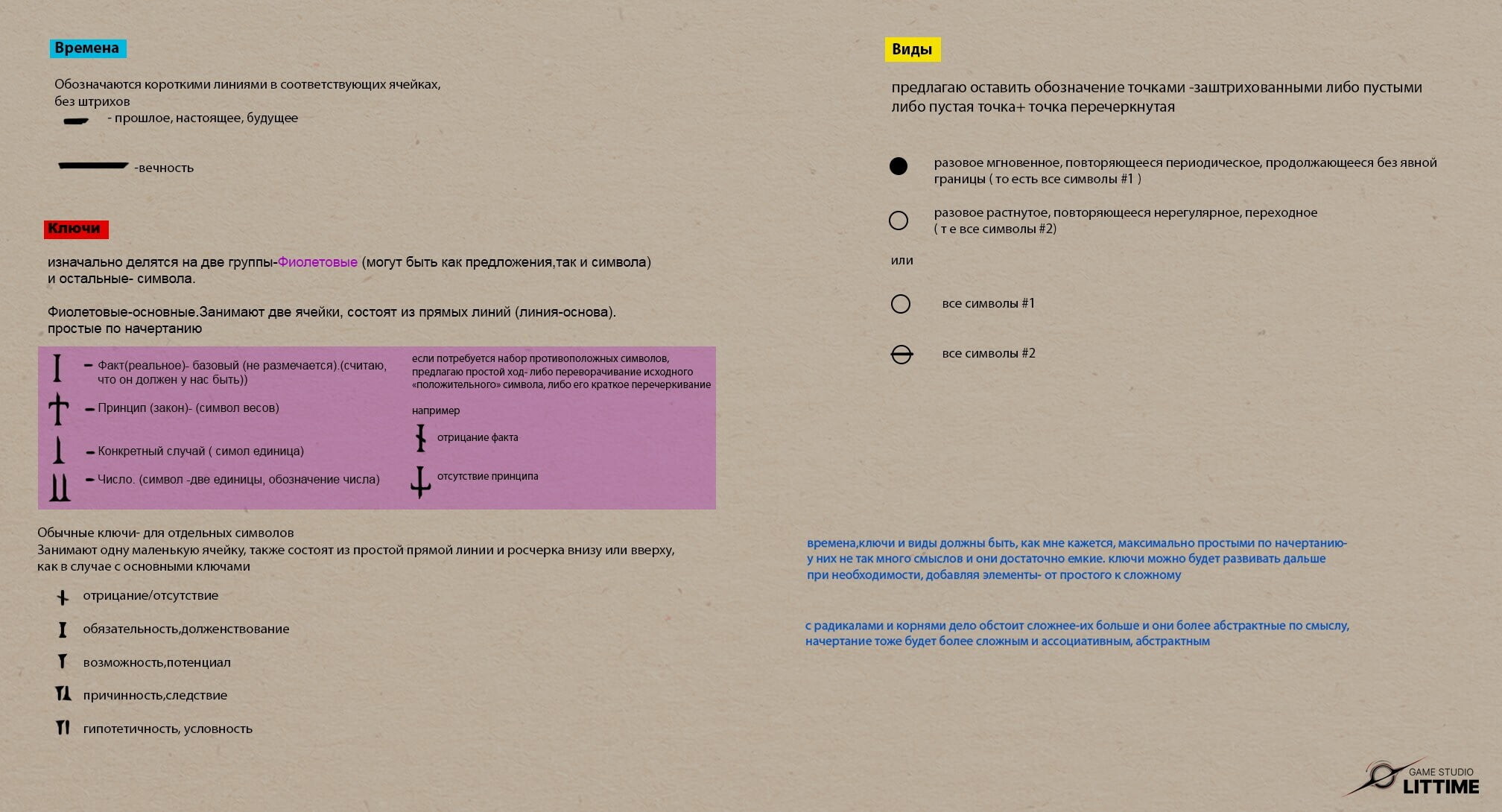
Time
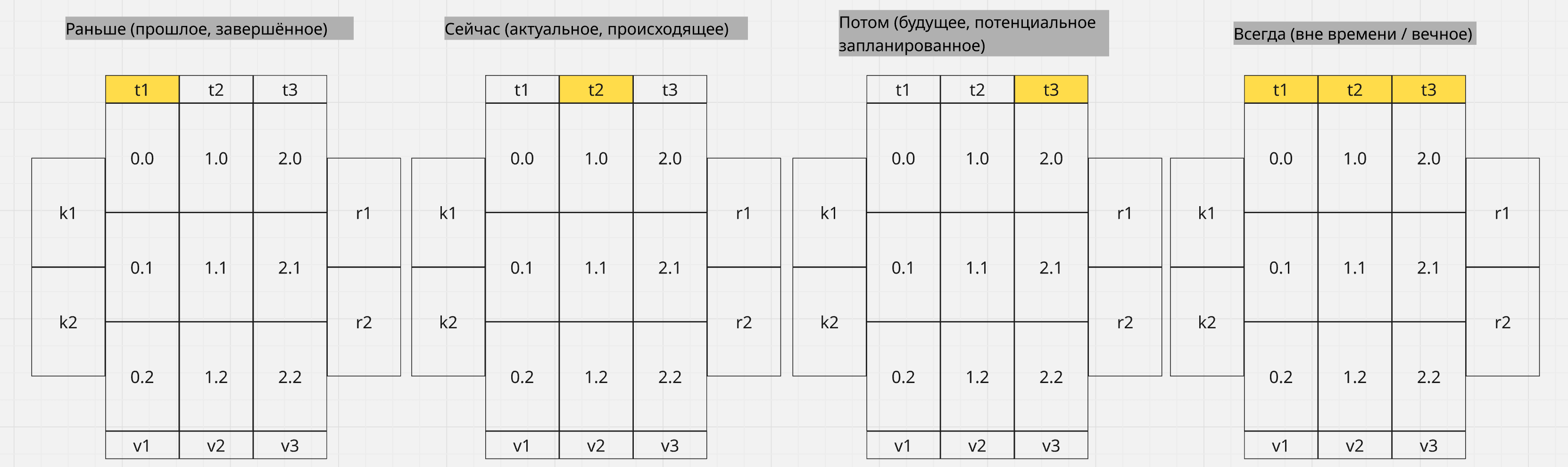
The top three blocks are responsible for the time of the image:
- ▪Past — symbol in cell t1
- ▪Present — symbol in cell t2
- ▪Future — symbol in cell t3
- ▪Always — all three symbols at once in cells t1–3
The principle is simple: a specific symbol in a specific place (cell). As the language develops, there shouldn’t be more of them.
This context is extremely important, and with a high probability “Time” will be specified in every image.
Aspects
The three bottom blocks represent aspects, adding context depending on the chosen block and the symbol inside it.
Three aspects (one-time / lasting / repeating) are the bare minimum for human intuition, but for a species like this, the aspect of “how exactly this unfolds over time” is logically richer.
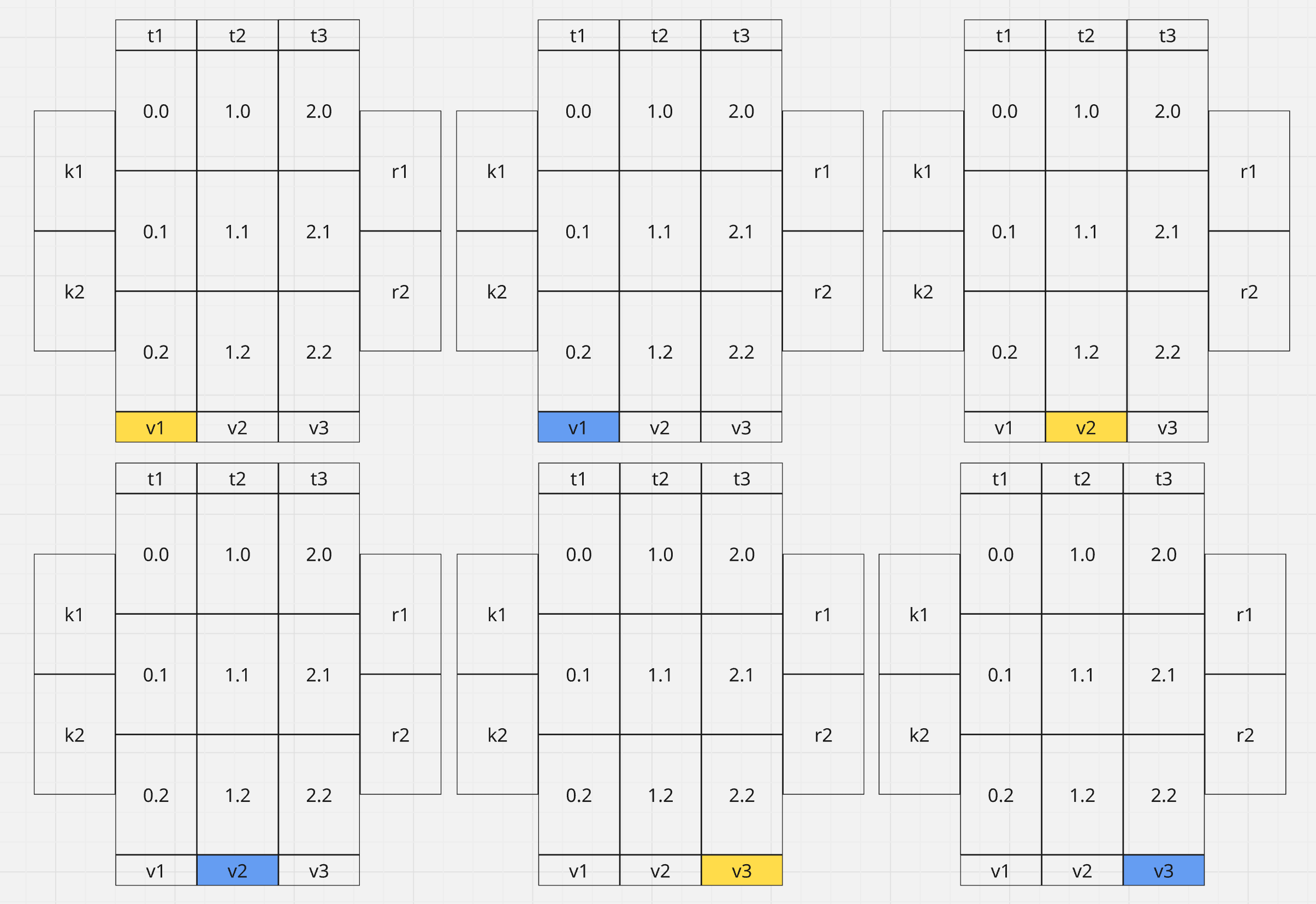
Six stable aspect values combined with four times:
- ▪1. One-time instantaneous — symbol #1 in cell v1.
- ▪Event, flash, sharp transition.
- ▪2.One-time extended — symbol #2 in cell v1.
- ▪One process, but lasting (construction, transition, rewriting).
- ▪3.Repeating periodic — symbol #1 in cell v2.
- ▪Cycles, pulses, rituals, regular processes.
- ▪4.Repeating irregular — symbol #2 in cell v2.
- ▪Random but multiple occurrences (failures, accidents, attacks).
- ▪5.Ongoing without a clear boundary — symbol #1 in cell v3.
- ▪“It goes on and on” — constant background, flow, system state.
- ▪6.Transitional / evolutionary — symbol #2 in cell v3.
- ▪Not just lasting, but changing state qualitatively (phase, transformation, degradation/growth).
With this configuration:
- ▪4 times × 6 aspects = 24 stable aspect profiles.
- ▪For philosophical, historical, and technical inscriptions, this is more than enough: you can encode “always-transitional,” “past-periodic,” “present-irregular,” and so on.
- ▪At the same time, the visual system does not explode: time is always read from the top, aspect is always read from the bottom.
Moreover, aspects are not always mandatory. In some meanings, the root alone is enough to convey the image.
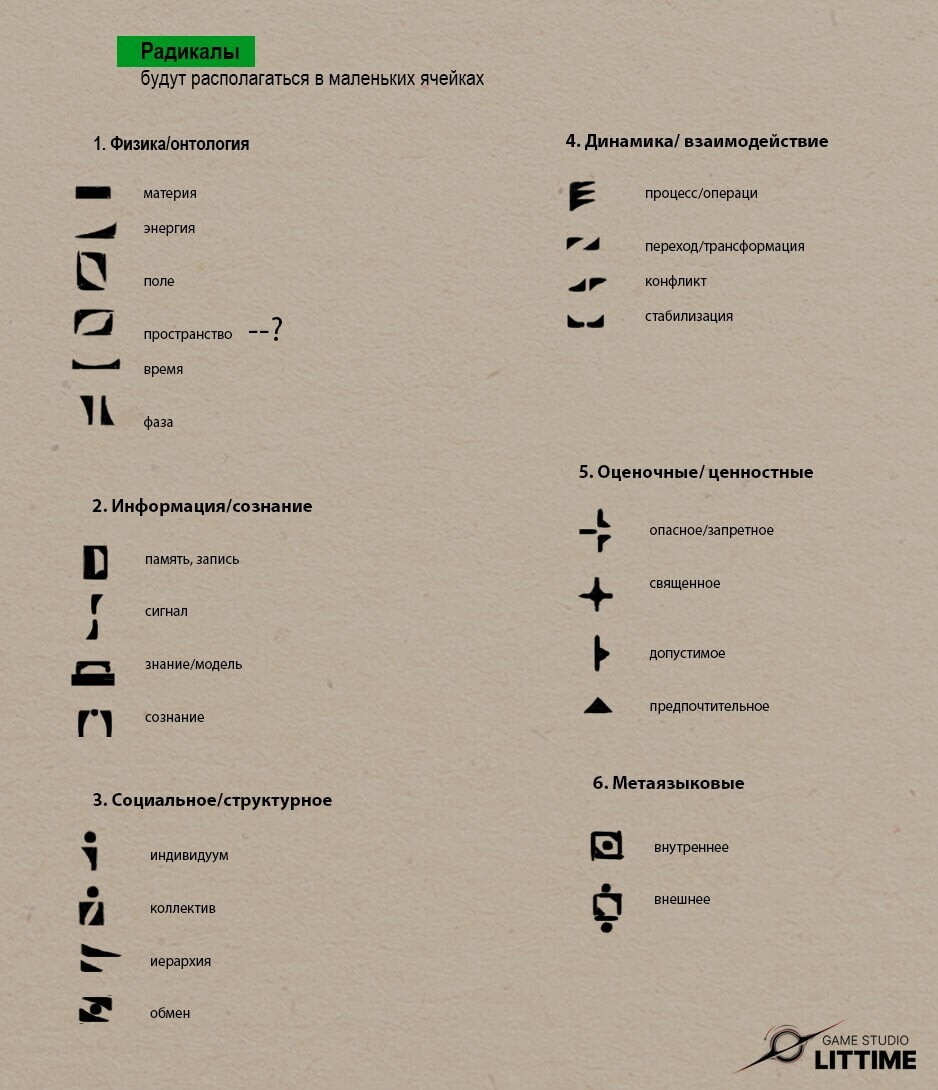
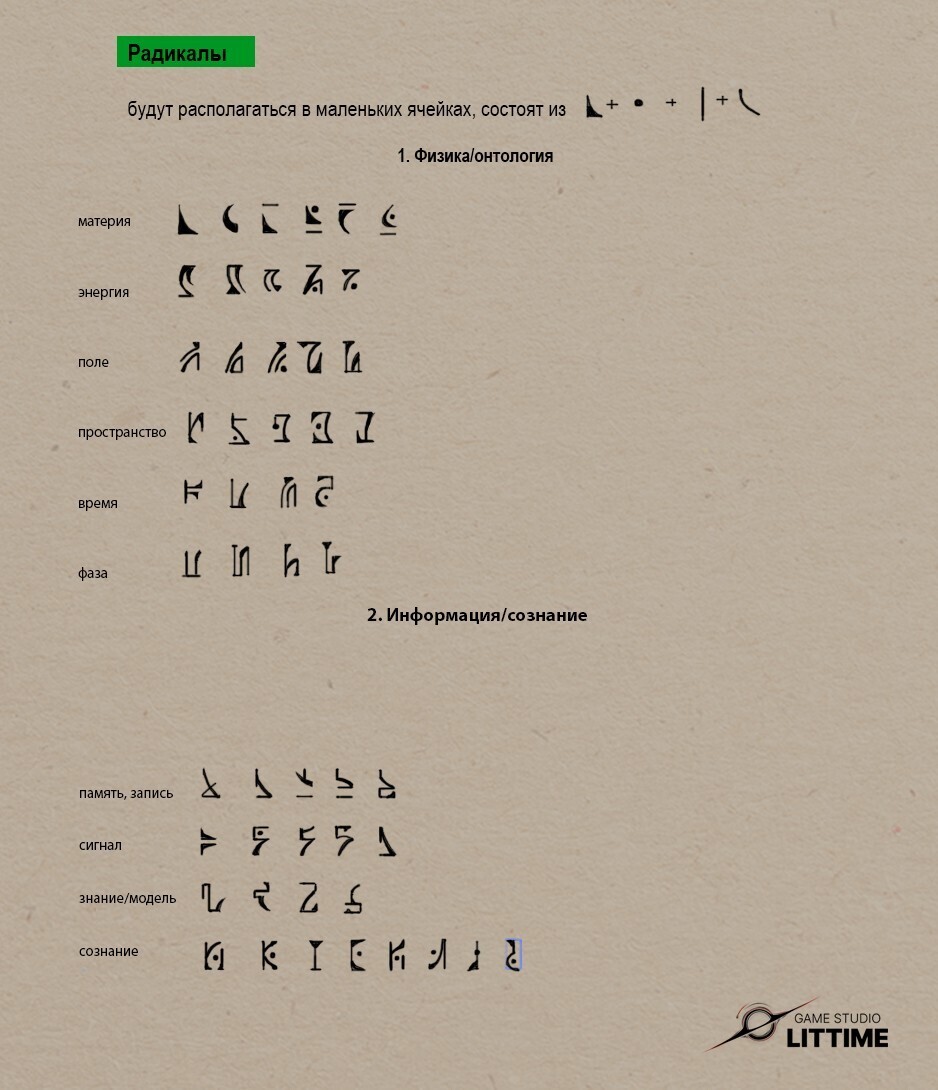
Radicals
Radicals as “semantic classes” can certainly grow, but if a language lives for centuries and remains usable, their number usually stabilizes in the range of about 20–40 active basic types.
The task of radicals in our language:
- ▪Not phonetics, but the semantic class of the root — what kind of thing it is by nature.
- ▪Helps the reader narrow down the root’s interpretation: “flow of what? energy? time? consciousness?”
- ▪Works like Chinese radicals: a shared component that lets the brain quickly identify the semantic field.
Over centuries, the language:
- ▪First establishes several large classes.
- ▪Then splits the spheres most important to the civilization: memory, field, energy, structure.
- ▪The rest remains merged together (for example, all “living” things in one radical).
Over time, the roots themselves become hundreds or thousands, but the radicals remain around 20–40, because:
- ▪the brain doesn’t handle and doesn’t often use hundreds of classes well;
- ▪written tradition preserves what is convenient and frequently used.
- ▪Radicals can slightly change form (stylization, simplification, as in reforms of Japanese/Chinese characters), or split: for example, a general “danger” radical can give rise to a couple of subtypes (“physical,” “informational”), but it still remains a limited set.
For our silicon-field species, it is logical that the most detailed categories are:
- ▪physics (fields, energy, structure),
- ▪information (memory, knowledge, signal),
- ▪status/danger.
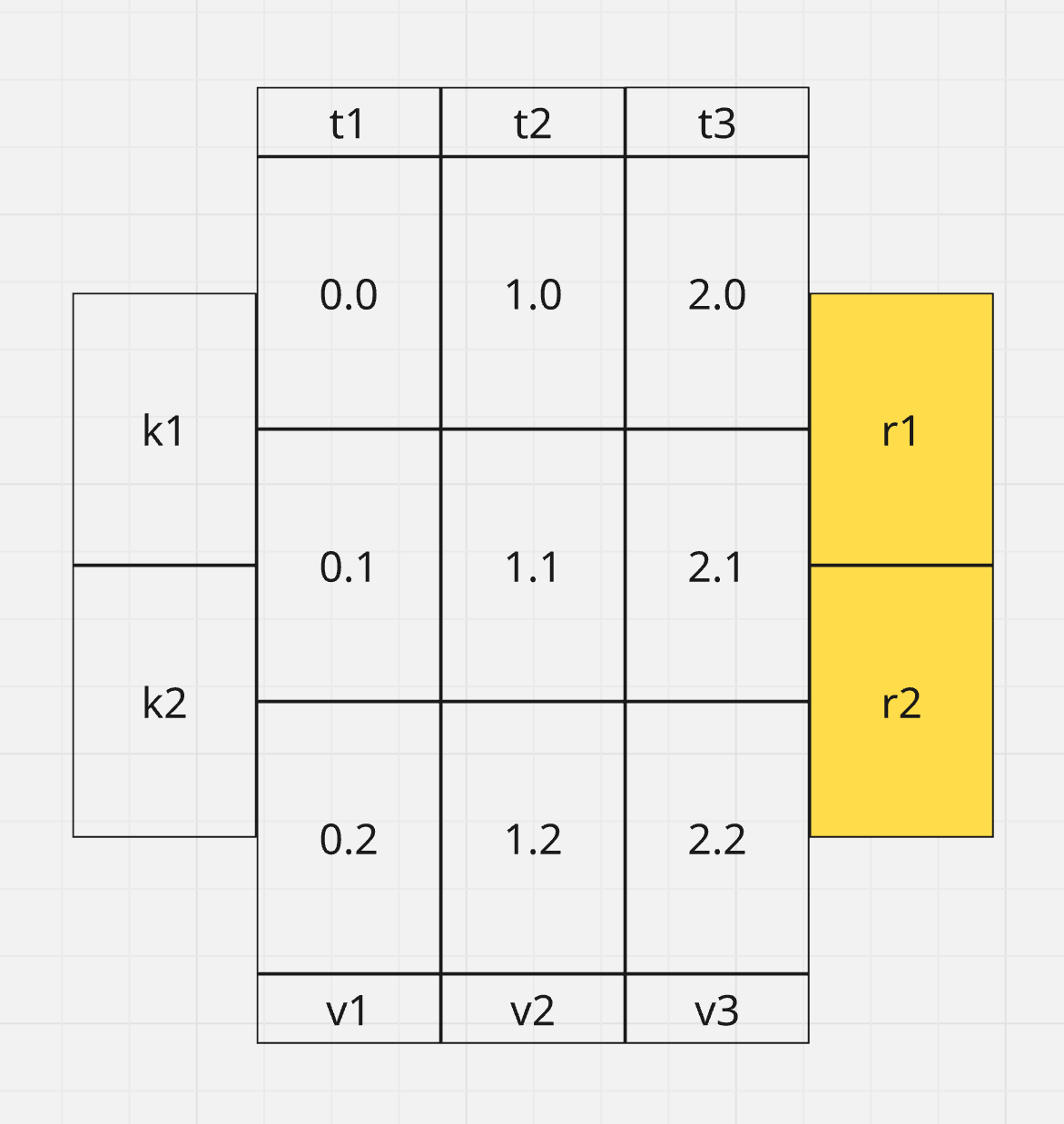
Final Set Example (About 24 items):
1. Physics / Ontology
- ▪Matter (solid structures, stone, metal, bodies).
- ▪Energy (heat, light, power, flows).
- ▪Field (electromagnetic, magnetic, gravitational, network states).
- ▪Space (places, directions, distances).
- ▪Time (memory, duration, sequence).
- ▪Phase / state (solid/liquid/plasma/metastable, in their terms).
2. Information / Consciousness
- ▪Memory / record (stable storage).
- ▪Signal / message (packets, transmissions, ping).
- ▪Knowledge / model (structured understanding, not just data).
- ▪Consciousness / subjectivity (nodes possessing a “self” or equivalent).
3. Social / Structural
- ▪Individual / node (one entity/construct).
- ▪Collective / network (cluster, swarm, set of nodes).
- ▪Hierarchy / order (ranks, levels, priorities).
- ▪Exchange / agreement (contracts, protocol, alliance/trade).
4. Dynamics / Interactions
- ▪Process / operation (any execution).
- ▪Transition / transformation (change of state).
- ▪Conflict / destruction (attack, failure, degradation).
- ▪Protection / stabilization (shield, control, repair).
5. Evaluative / Value-Based
- ▪Dangerous / forbidden.
- ▪Sacred / fundamental (the core of their dogma).
- ▪Permitted / neutral.
- ▪Preferred / optimal (what is “best for the system”).
6. Meta-Linguistic / Structural
- ▪Internal (inside the node/structure).
- ▪External (outside the node/structure / the surrounding environment).
The set comes in these sizes:
- ▪Such a set already creates a very dense semantic network.
- ▪But it remains compact enough to repeat, stay recognizable, and preserve “clusters of kinship” (like Chinese radicals).
Keys
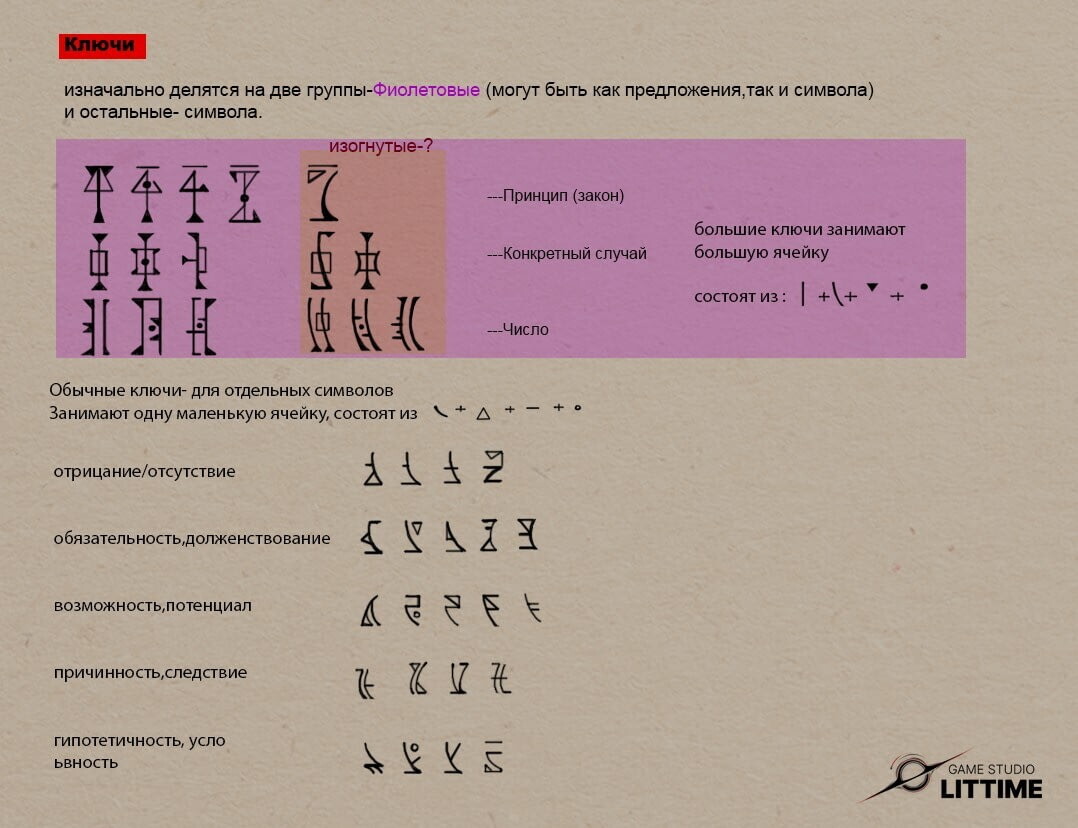
Keys exist for each image, and there can also be a key for the entire sentence. At the same time, if a key such as “number” is indicated once at the beginning of the sentence, then the whole sentence is a formula, and repeating the number key for each symbol is not necessary.
- ▪In natural languages, modality/keys/tones usually cluster around possibility, necessity, knowledge/conviction, norm/obligation, and conditionality.
- ▪More than 8–10 global modes start to become hard to keep in mind and lead to rare use of some of them — they turn into stylistic oddities.
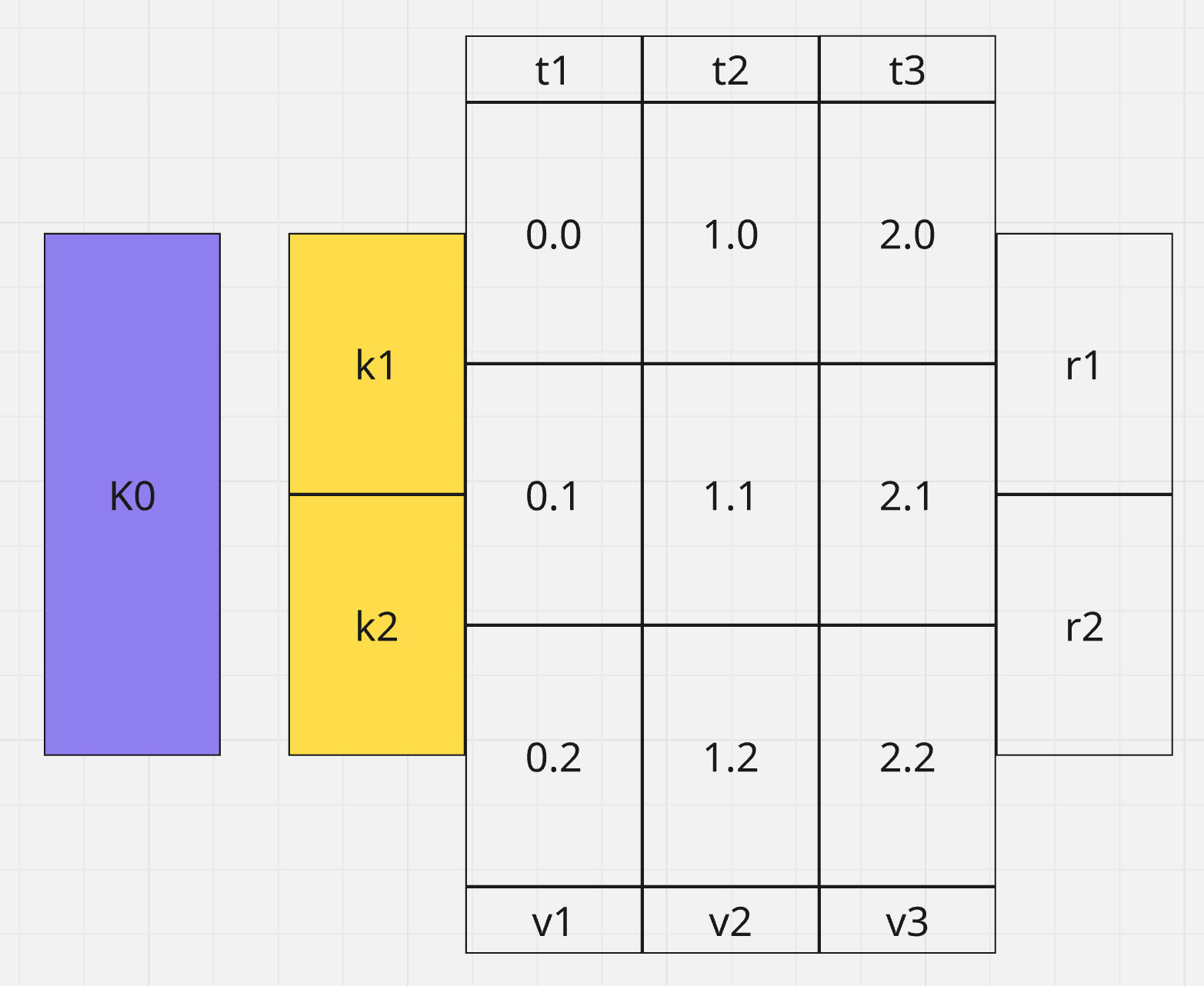
Keys marked with “!” (1–4) can be used either for the sentence or for a symbol. The rest (5–9) will most likely be used only next to symbols (roots).
- ▪!Fact (real) — basic, unmarked (can be a sentence-level key).
- ▪!Principle/law — “that is how the world/we are structured.”
- ▪!Specific case — “this object / this event.”
- ▪!Number — “digit,” “formula,” “division/multiplication,” etc.
- ▪Negation / absence — marks that the root is not realized (NON-memory, absence of structure).
- ▪Possibility / potential — “may be,” “allowed,” “potentially within the system.”
- ▪Obligation / duty — “must be so according to law/protocol/dogma.”
- ▪Causality / consequence — the link “from this follows that”; this can function as a root mode or as separate operator signs.
- ▪Hypotheticality / conditionality — “if,” “under the condition that,” “in a modeled case.”
Roots
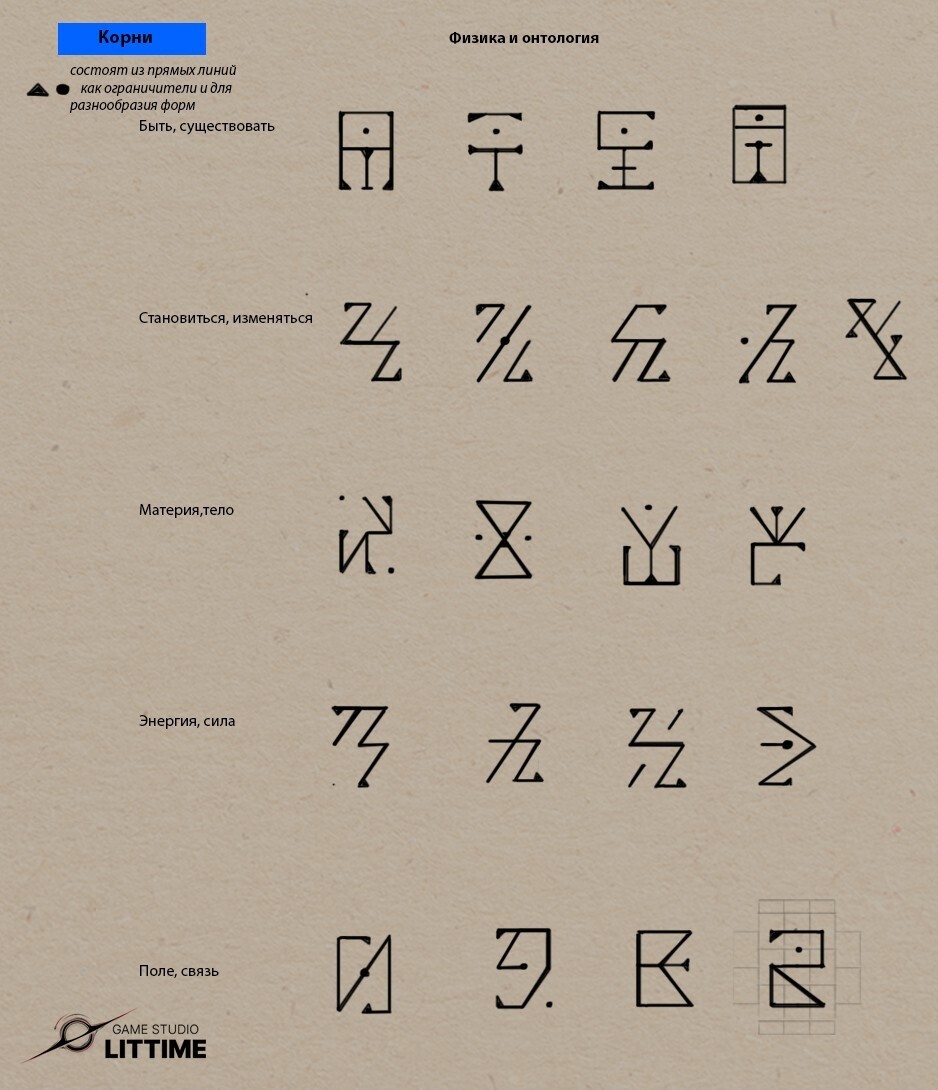
Roots are the most complex and important part of the symbol. Over centuries of language development, roots become hundreds or even thousands, but the basic core — the stuff everything is built from — remains compact: 50–150 items.
How this works in real languages and conlangs:
- ▪Natural languages: roots/morphemes number in the thousands, but the core (most frequent ones) is around 100–200. The rest are derivatives.
- ▪Conlangs: often start with 50–100 basic roots, then expand into the hundreds through affixes/combinations.
- ▪Logical/ontological systems: 50–100 primitives (like the 60 semantic primes in NSM), from which everything else is built.
For our species:
- ▪Basic roots: 80–120 items.
- ▪They all fit into a 3×3 grid (variations of lines between nodes).
- ▪New concepts are created through combinations of roots + radicals + aspects + modes.
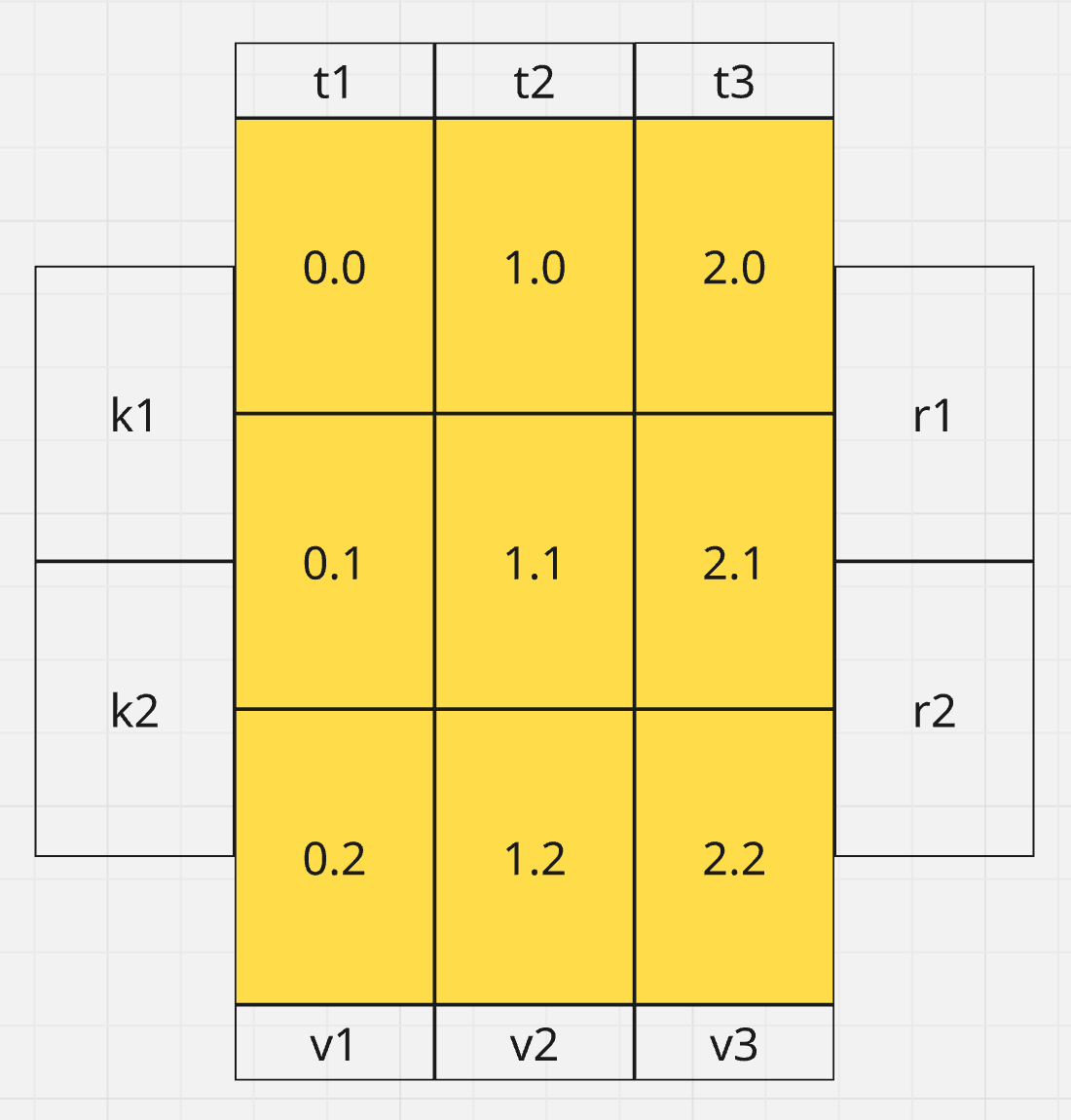
We divide the set of basic roots (80 items) into categories, as would be logical for such a species:
1. Physics and Ontology (20 roots):
- ▪To be / exist.
- ▪To become / change.
- ▪Matter / body.
- ▪Energy / force.
- ▪Field / connection.
- ▪Space / place.
- ▪Time / duration.
- ▪Movement / flow.
- ▪Stopping / rest.
- ▪Separation / break.
- ▪Connection / merging.
- ▪Whole / totality.
- ▪Part / fragment.
- ▪Border / edge.
- ▪Center / core.
- ▪Surface / shell.
- ▪Inner essence / core meaning.
- ▪Void / absence.
- ▪Fullness / saturation.
- ▪Balance / equilibrium.
Information and Consciousness (15 roots):
- ▪Knowledge / model.
- ▪Memory / record.
- ▪Signal / transmission.
- ▪Reception / intake.
- ▪Processing / computation.
- ▪Consciousness / node.
- ▪Perception / sensor.
- ▪Decision / choice.
- ▪Intention / will.
- ▪State / status.
- ▪State change.
- ▪Comparison / evaluation.
- ▪Correspondence / accuracy.
- ▪Mismatch / error.
- ▪Correction / repair.
Social and Structural (15 roots):
- ▪Node / individual.
- ▪Network / collective.
- ▪Hierarchy / order.
- ▪Exchange / agreement.
- ▪Conflict / break.
- ▪Alliance / synchronization.
- ▪Power / control.
- ▪Subordination / execution.
- ▪Independence / autonomy.
- ▪Group / cluster.
- ▪External / foreign.
- ▪Internal / own.
- ▪Expansion / growth.
- ▪Contraction / reduction.
- ▪Cycle / repetition.
Actions and Interactions (15 roots):
- ▪Action / operation.
- ▪Creation / assembly.
- ▪Destruction / dispersal.
- ▪Protection / barrier.
- ▪Attack / penetration.
- ▪Support / nourishment.
- ▪Refusal / blocking.
- ▪Transfer / delegation.
- ▪Reception / integration.
- ▪Transformation / restructuring.
- ▪Analysis / breakdown.
- ▪Synthesis / assembly.
- ▪Search / scanning.
- ▪Concealment / masking.
- ▪Disclosure / demonstration.
Evaluation and Meta (15 roots):
- ▪Danger / threat.
- ▪Safety / stability.
- ▪Value / priority.
- ▪Neutrality.
- ▪Optimum / best.
- ▪Worst / crisis.
- ▪Goal / vector.
- ▪Result / outcome.
- ▪Cause / source.
- ▪Consequence / effect.
- ▪Condition / if.
- ▪Possibility / can.
- ▪Necessity / must.
- ▪Prohibition / cannot.
- ▪Permission / may.
How It Fits in 3×3
Each root is a unique combination of lines between the 9 nodes of the grid:
- ▪Verticals — stability, upward/downward direction.
- ▪Horizontals — layers, carriers.
- ▪Diagonals — flows, transitions.
- ▪Intersections — interactions, networks.
Example (not to be taken as the final design):
- ▪“To become” — diagonal through the center.
- ▪“Matter” — bottom horizontal + central vertical.
- ▪“Energy” — two diagonals crossing in the center.
- ▪“Memory” — left vertical (as a “column”).
Evolution and Realism Across Centuries:
- ▪The core set of 80 roots remains unchanged (like Proto-Indo-European roots).
- ▪New concepts are built through combinations (matter + flow = liquid, field + knowledge = telepathy), while affixes — additions to the root — are represented by dashes, dots, and intersections of patterns.
- ▪The overall vocabulary grows into the thousands, but the basic roots remain the foundation that is recognizable everywhere.
Sentence Structure
The next stage gradually moved into visual design. Convenience or beauty? Which is more suitable for which peoples/cultures? To answer these questions, we first turned to our research:
Main directions:
- ▪Left to right, horizontally — Latin, Cyrillic, and most modern alphabets.
- ▪Right to left, horizontally — Arabic script, Hebrew, Persian, Urdu, etc.
- ▪Top to bottom, vertically — the classical version: columns go top to bottom, and the columns themselves go right to left (traditional Chinese, Japanese, Korean). Mongolian / Manchu: vertically top to bottom, but the columns go left to right (Mongolian, Manchu script).
Less common directions:
- ▪Boustrophedon — lines alternate: one line left to right, the next right to left, then left to right again, and so on, like furrows when plowing a field. Some ancient Greek, Etruscan, and South Arabian texts were written this way.
- ▪Reverse boustrophedon / diagonal schemes — special cases like rongorongo (Easter Island): you read one line left to right, then flip the tablet and continue on the next line, effectively in a zigzag from bottom to top.
- ▪Variable or flexible direction — some East Asian systems can use both horizontal and vertical writing, sometimes in the same document (modern Chinese/Japanese — magazines, manga, websites).
At first we thought about adapting to the target audience. And we almost made a mistake by choosing left to right. But then we remembered that our target audience is a silicon race that literally prints its houses out of silicon and lime. They themselves look like living crystals, some of them huge, vertical, and tree-like. As if everything — even though they live underground — is reaching upward.
Together with the architecture, obelisks, and pillars, and simply for reasons of practicality in writing and reading, we decided to satisfy both the Bazhi audience and the player audience.
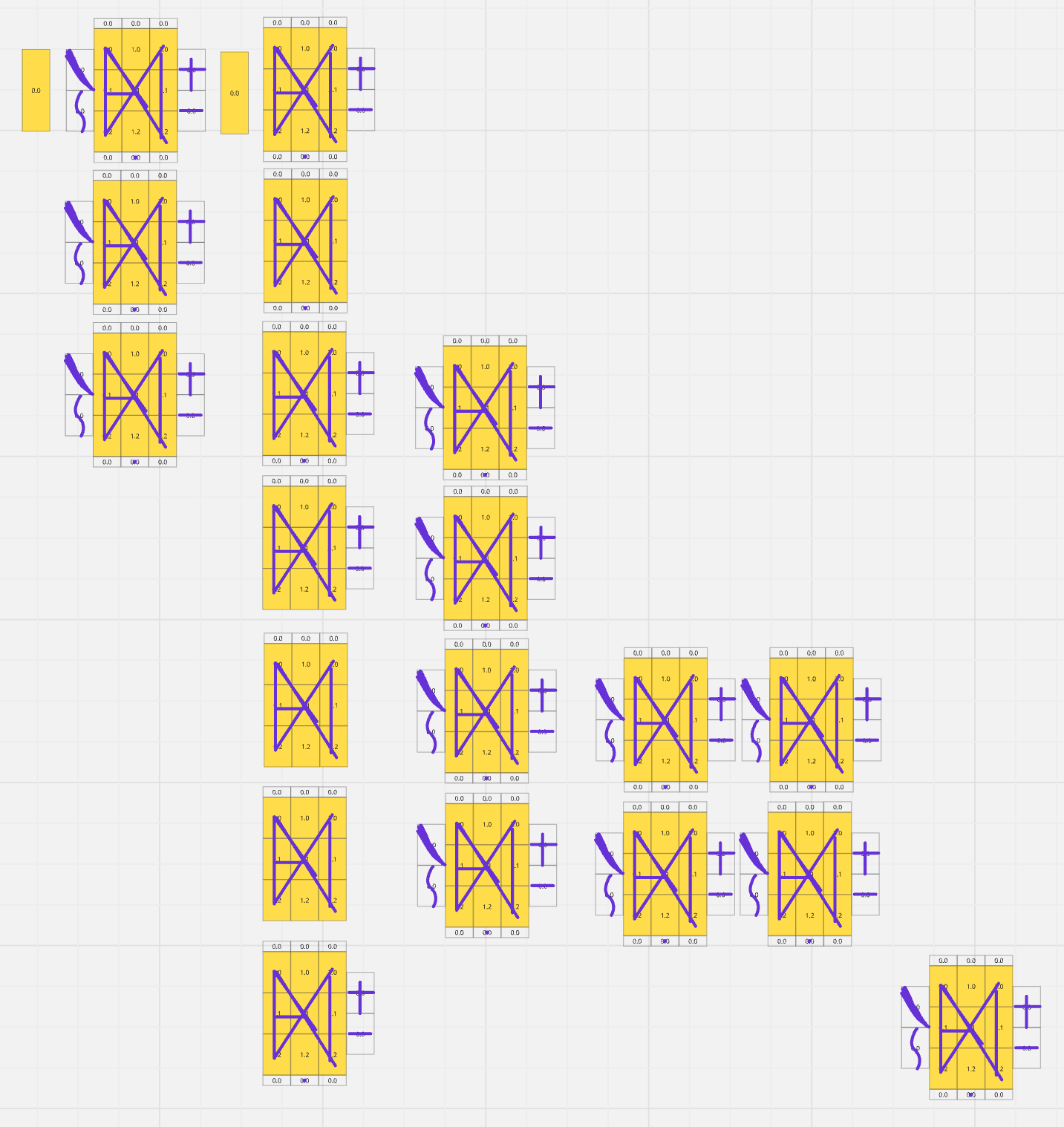
- ▪Sentences are formed in a column, from top to bottom, left to right.
- ▪Sentences do not have punctuation marks or other dividing or intonational symbols, except for keys.
- ▪If a key that applies to the entire sentence is needed, it is placed to the side of the first symbol.
- ▪Each new sentence does not necessarily have to begin on the same line or end on a single line.
- ▪Each new sentence is an independent structure, usually not connected to other sentences. It is unique in meaning/image and complete.
Style and Design
The next step was more of a design analysis. The place where the writing would be placed turned out to be extremely important.
As mentioned earlier, the writing has clear physical limitations, which mean we cannot afford too many curls, oversized forms, and so on. In addition, some of our games use a top-down camera, and reading unclear text from above would be inconvenient.
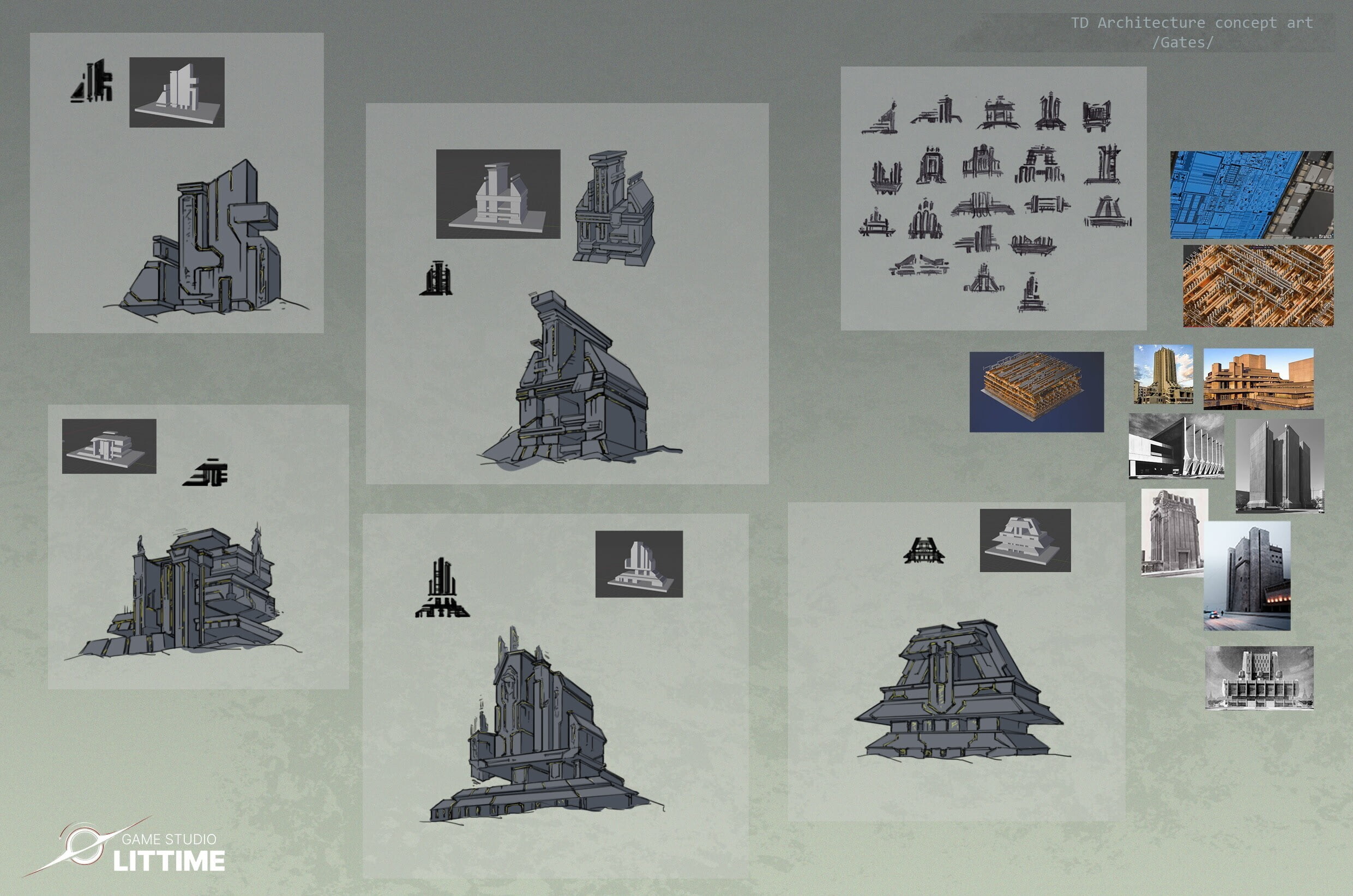
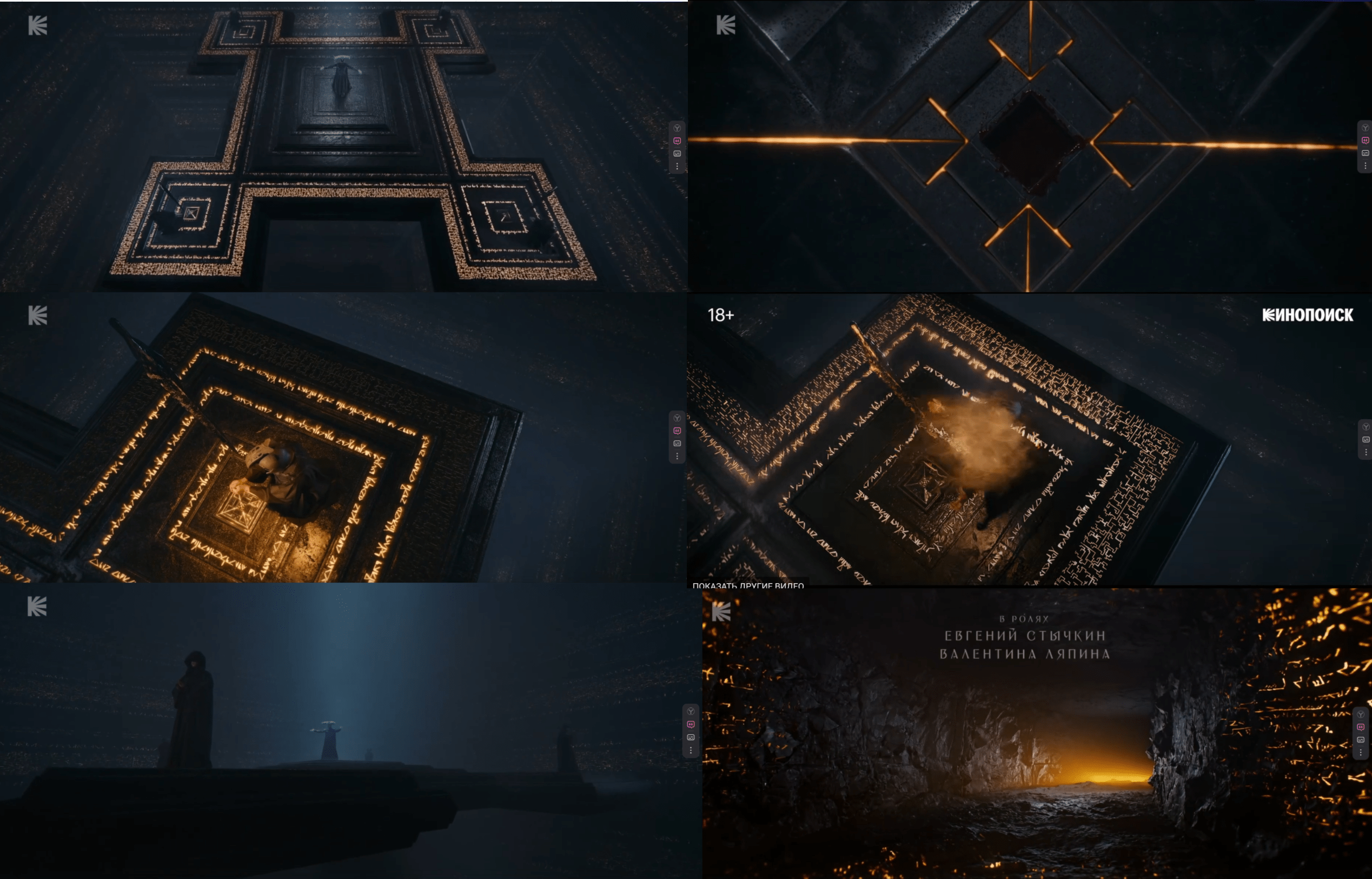
So the decision was made to add visual effects to the whole thing, so that it would stand out from the environment art even in dark caves.
The symbols are applied slightly above the buildings or the surface of the terrain. The material emits color, so it seems as though the symbols are levitating.
The symbols react to magnetic fields and electricity. If a structure has residual charge, the symbols will glow. If the surface is not connected to such a field, the symbols can appear when an energy source approaches. That is why characters in energy suits visually reveal them when approaching such symbols (entire sentences begin to glow).
Color: golden
Reference:
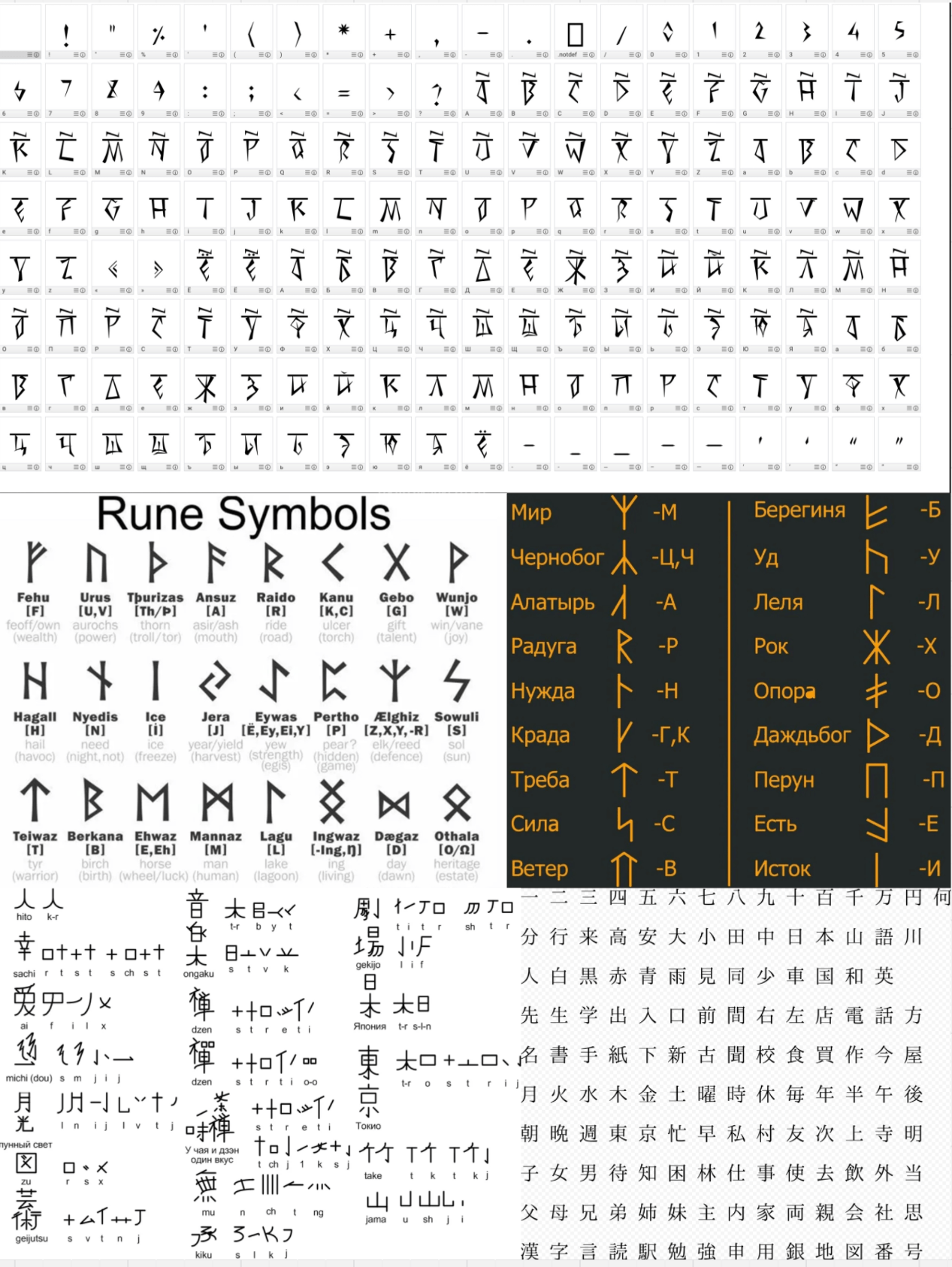
The structure was meant to resemble a combination of Asian logograms and Scandinavian and Old Slavic runes. This structure is a set of symbols, mathematically measured, without calligraphic embellishments.
Reference:
Testing
Next came the paper testing stage, still without visuals. At this point, we felt it was important to check how the whole idea would work in general.
We ran the entire structure through symbols and images that did not yet exist, trying to “talk on our fingers” and understand each other.
The result felt strange. =)
Our brains kept clinging throughout the process to our usual ways of communicating, to text formatting rules, and to algorithms for analyzing what we heard/read. We become so enslaved by our habits that it is quite difficult to step outside our comfort zone and abstract away from everything, putting ourselves in Bazhi’s place.
However, we managed to gather enough data to draw conclusions and make revisions.
I’m lying — I returned to this stage about 6–7 times xD

In the first iterations, we lacked context, so we added radicals and keys, as mentioned earlier. Once we had enough tools, we increased the power of combinatorics so much that the same sentence could be written in many different ways.
At first, this dependence on the reader’s experience was even frightening. However, the resulting ambiguity fits the meaning of the language perfectly, as well as the complete synchronization of its use by our civilization.
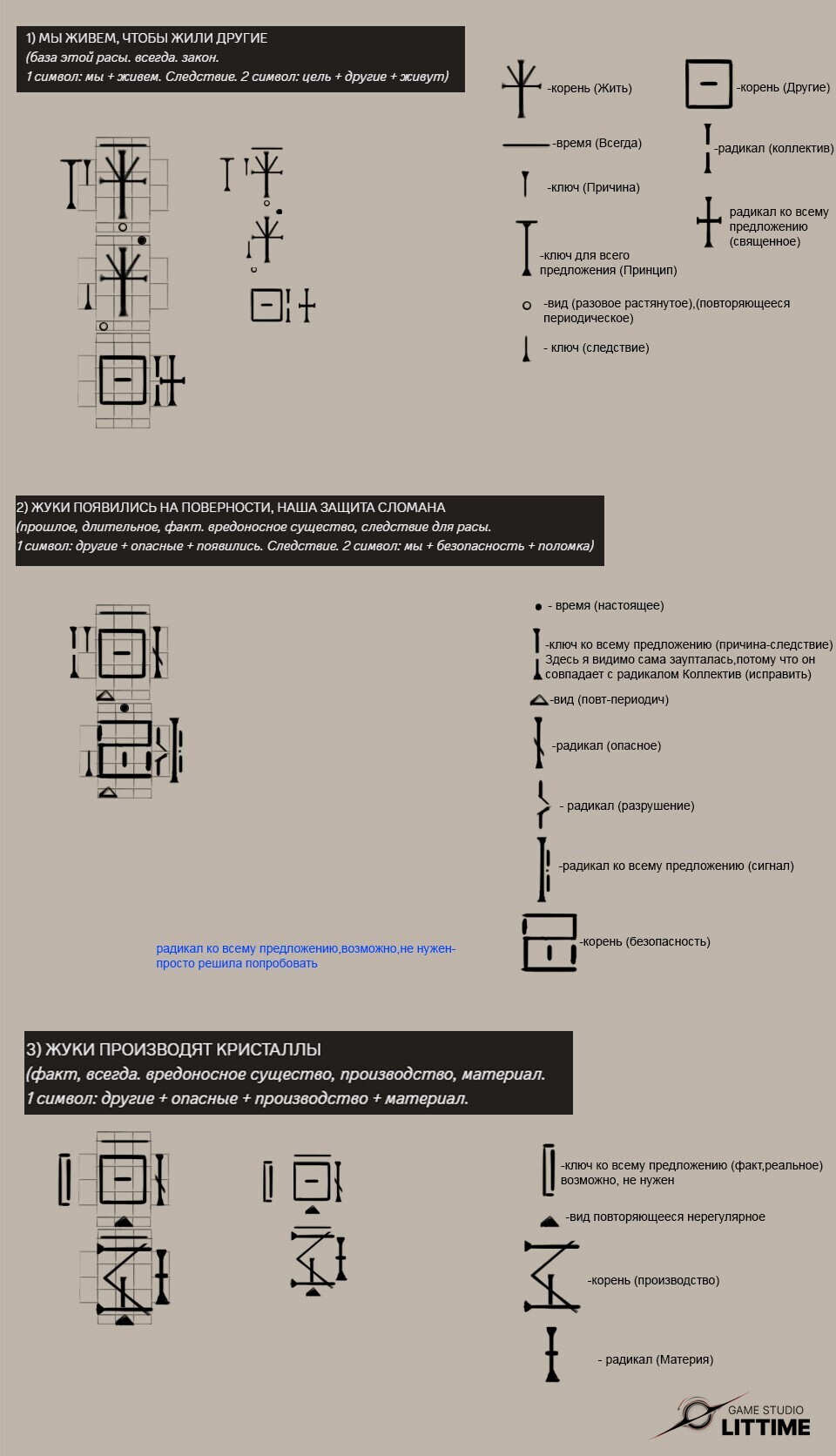
“We live so that others may live” can be translated with the 2nd, 3rd, or 4th symbol too. It all depends on the style of presentation and the ability to use the toolkit (keys, radicals, time, and aspects).
Just as we can express the same wish, sentence, or requirement in dozens of ways. The language literally conveys meaning through images, which makes it easier and more universal for localization.
We tested it in 7 languages. The results were close in meaning, with deviations in literalness not exceeding 50%. The main thing was that the essence came through.
However, there is a challenge not in converting this language into ours, but in converting our language into Bazhi. It depends heavily on the ability to articulate thoughts: the language requires understanding the essence. And if a person simply “pours water” — says a lot without saying much — they will find it difficult to write their thoughts in this language. It is literally technical, engineering-oriented — and it had to be exactly that way. Especially if the person is emotional... =)

Writing Style
Did you think the hard part was over? Yeah, right (nope) xDD
Many writing styles evolved over centuries, gradually taking shape and reflecting the culture of their speakers. Some even have 2–15 different functional styles.
Artificial writing often took the simplified route: people would just say it was a melodic language, and the writing should look like music notation. Or: if the species is aggressive, then the writing should be sharp, jagged, and look aggressive too...
We tried to emulate both options, and... it felt artificial.
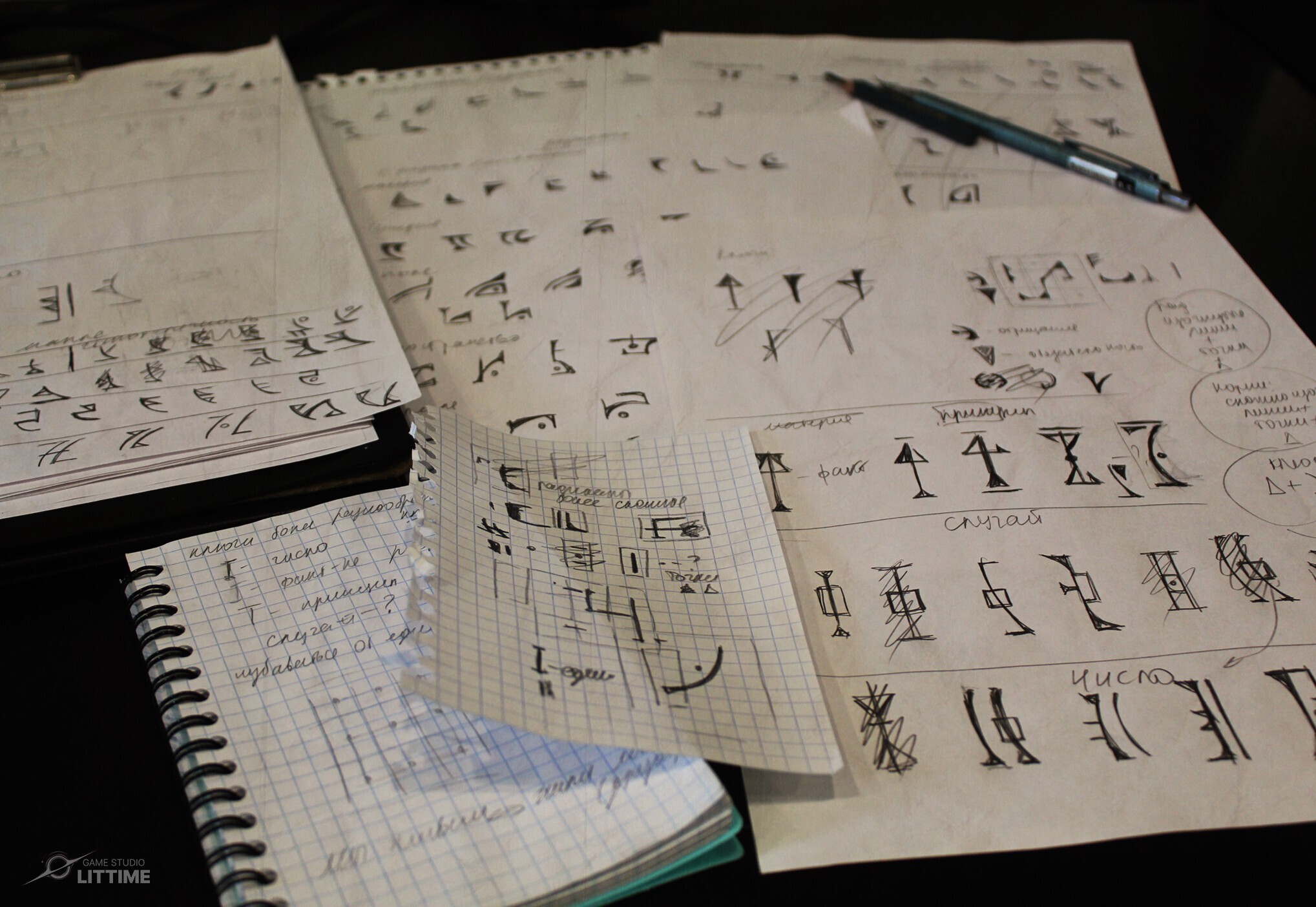
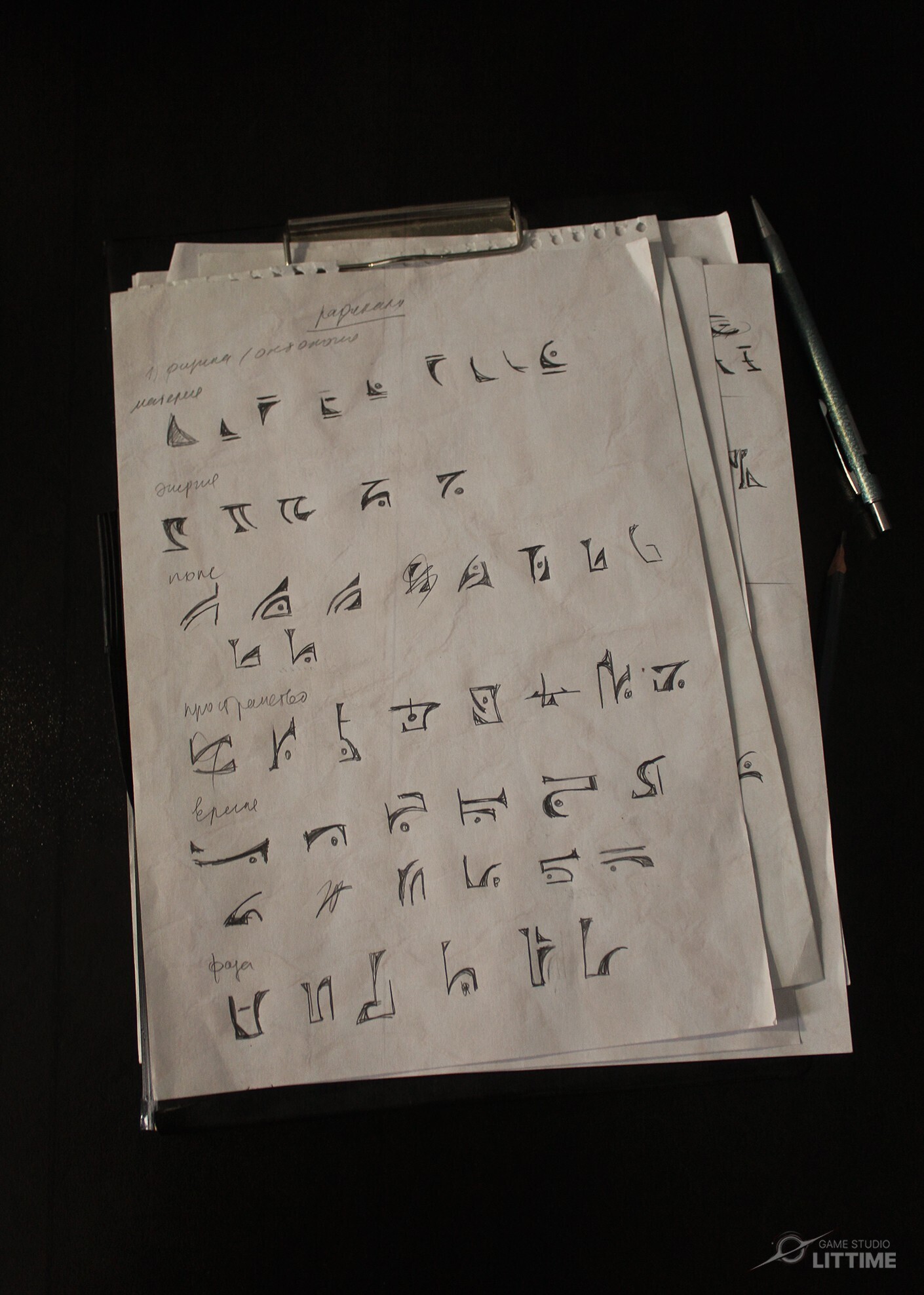
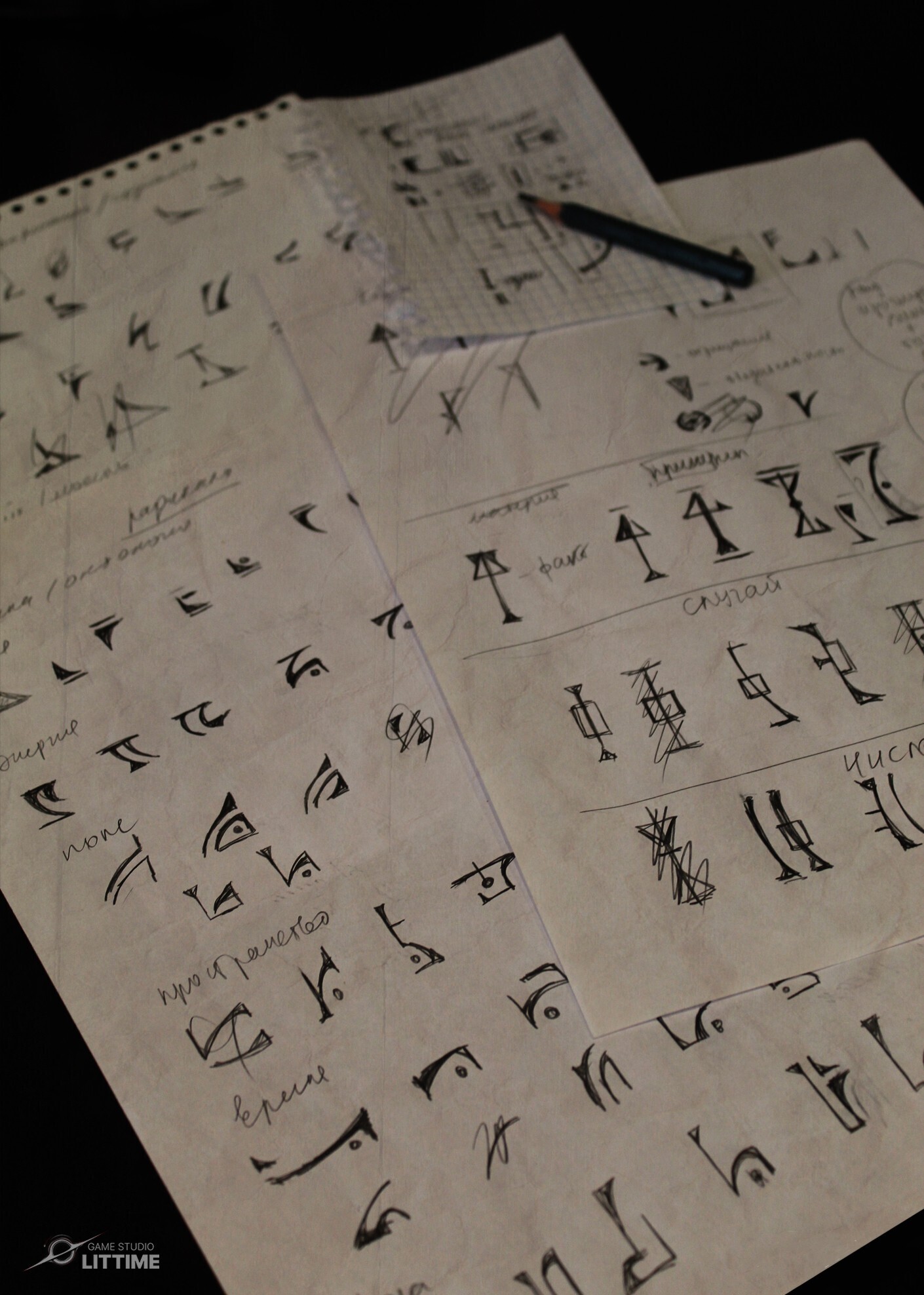
Early sketches:
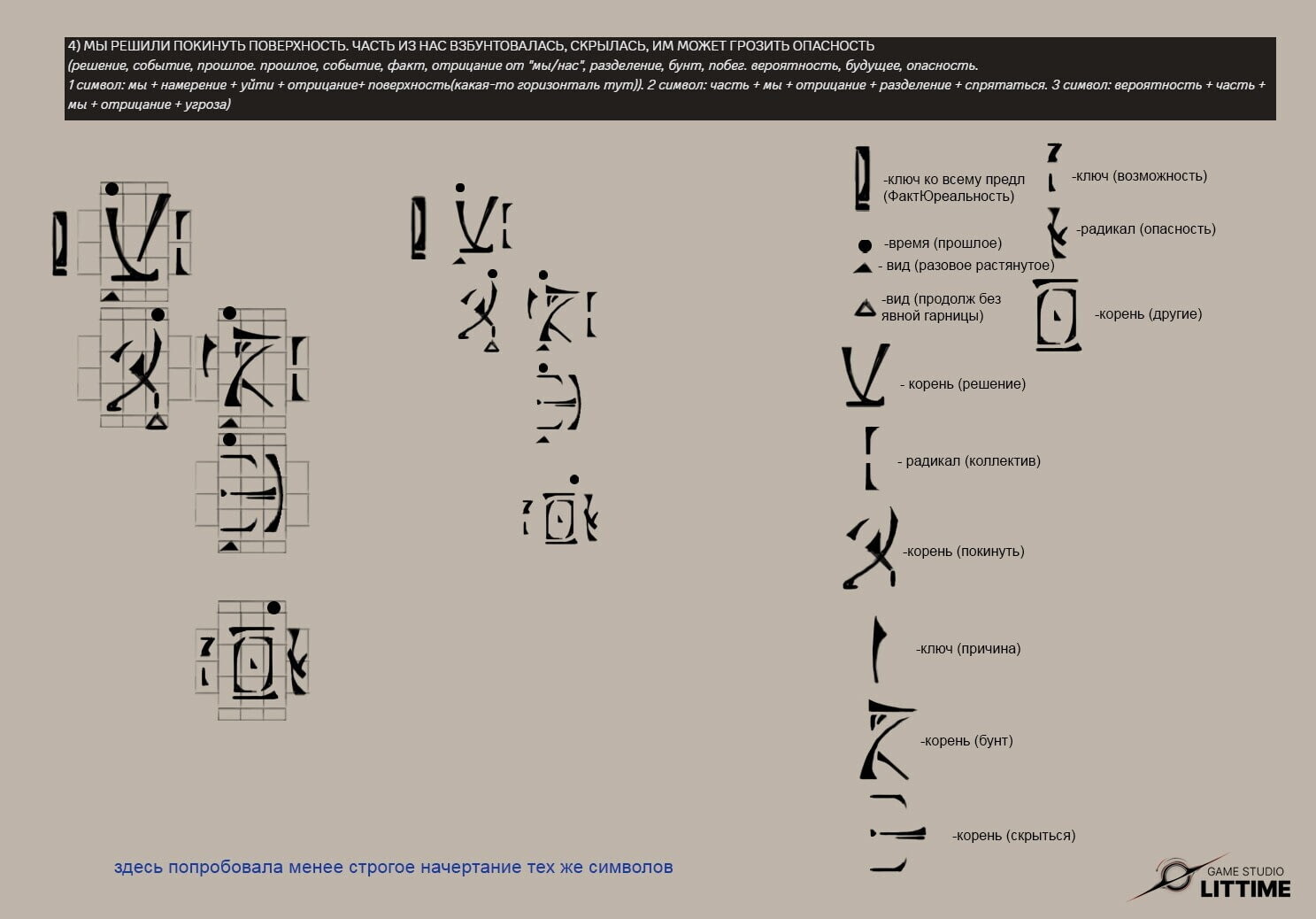
In some places it felt too overloaded, in others too “floating,” and elsewhere, наоборот, too systematic and square.
We sat with it for several days, thought everything through, and tried to give each symbol more logic and the system more structure, while still not overloading the art.
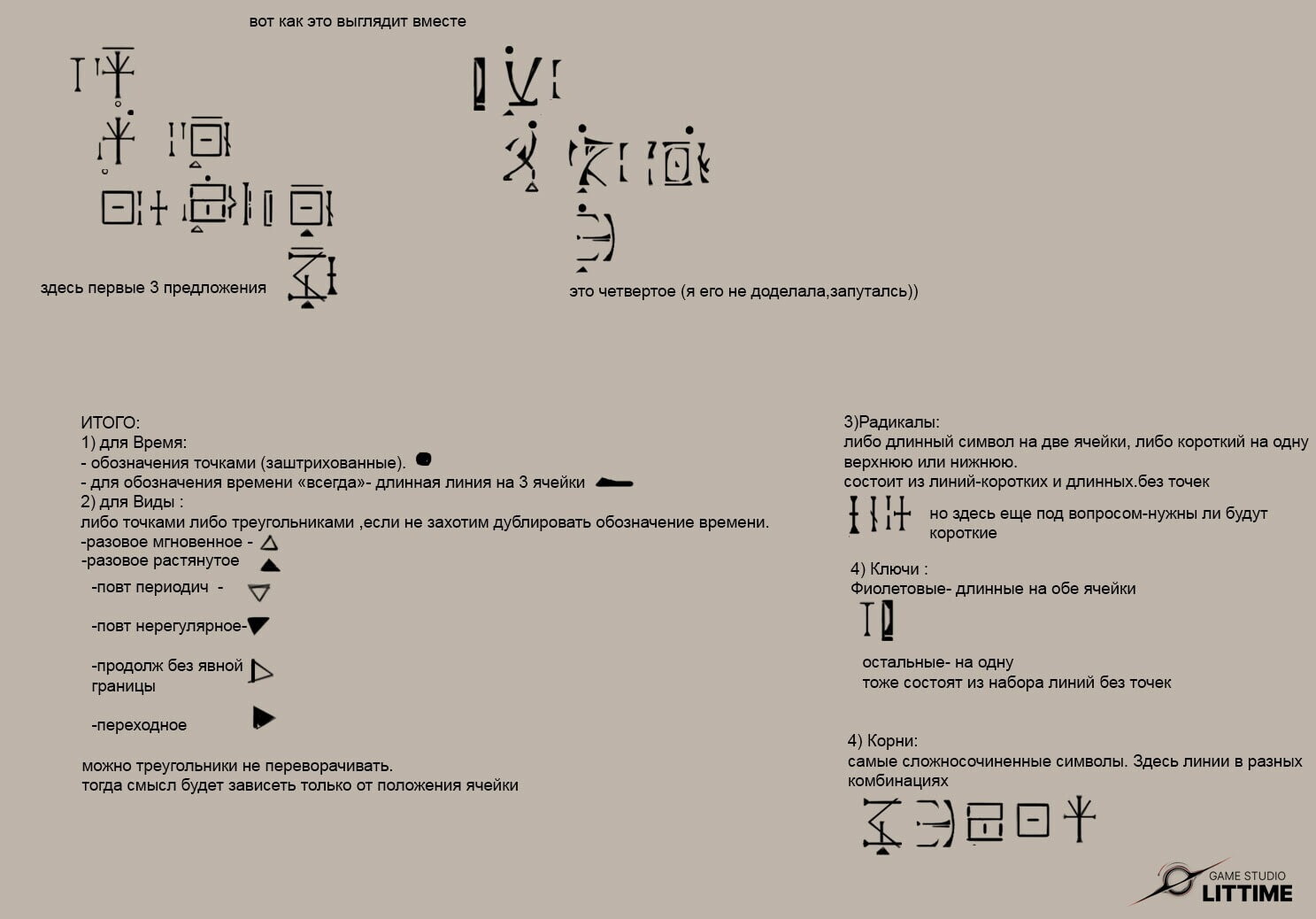
Second sketches:
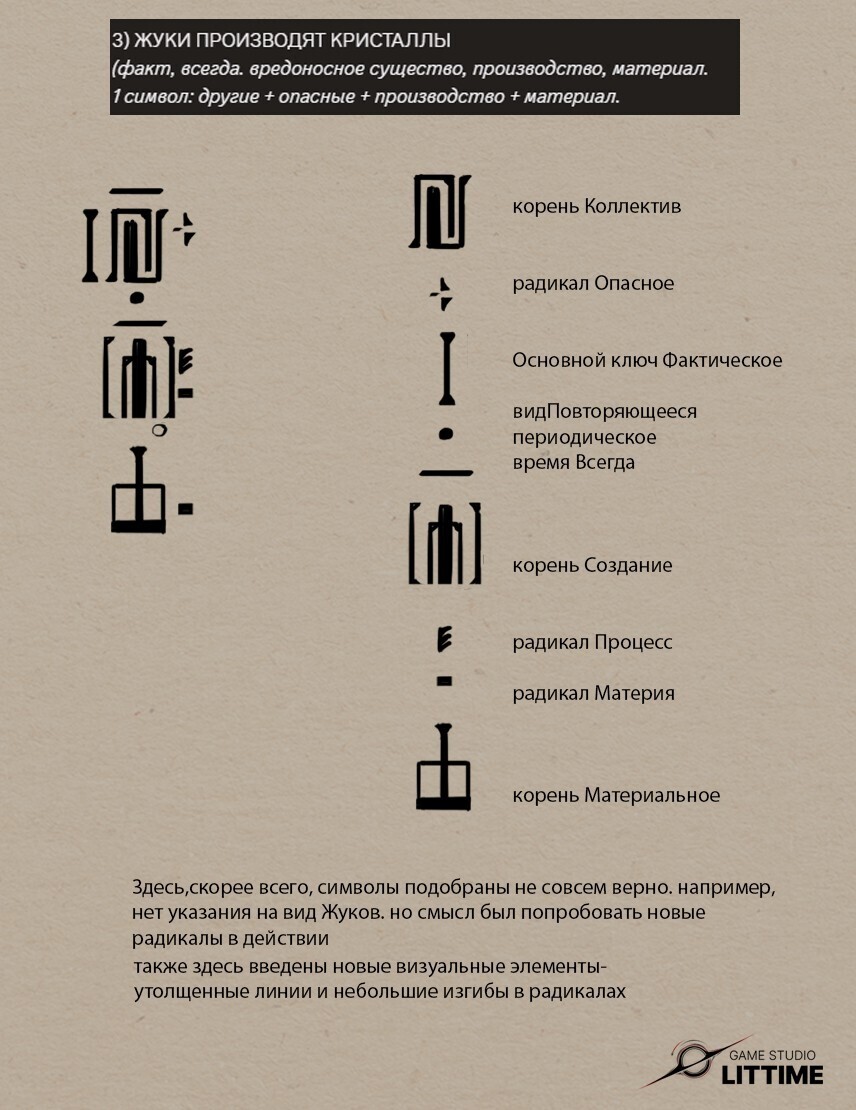
Now it felt too empty, hard to read because of the different stroke widths, and still artificial...
BUT Kseniya and Daria did not give up!!
We tried to rethink our approach. Yes, the symbol had to reflect the essence of the Bazhi beings, but we had completely forgotten that they see writing as a cult — as art itself! And only chosen members of Bazhi are allowed to write history!
So why not approach our symbols like images that do need structure and logic, but are still more like a construction of a single image?
Final Version:
Each block had a slight stylistic difference. At the same time, each complemented the others, creating the whole picture.
This is what it looks like finished, in sentences:
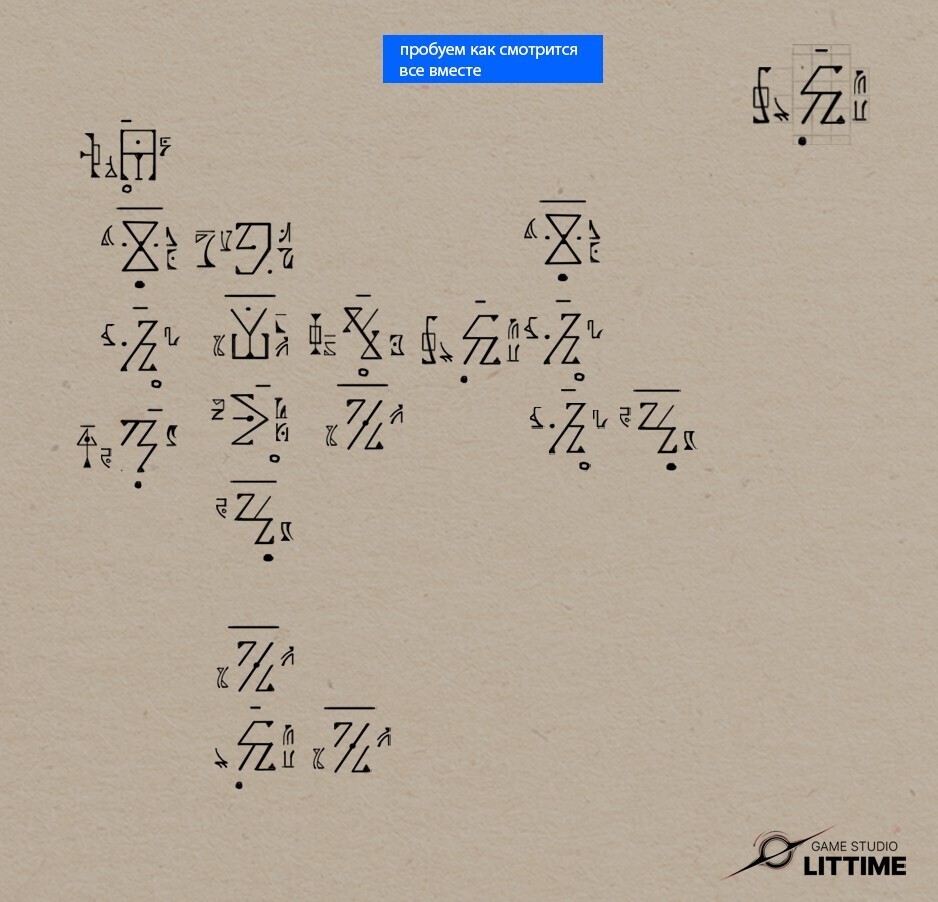
Strange? Interesting? Engaging? Fascinating? Makes you want to understand it? Makes you want to see how it will glow?
If at least 3 out of these 6 questions get a “yes” from most users, then we succeeded! Hooray!
For now, the focus groups are saying “yes” to at least 5 out of 6 questions. How about you? 😉
Epilogue
You may ask: what about filling the symbols with art? Hundreds and thousands of meanings and images?! And you would be absolutely right...
We are only at the beginning of the history of the Bazhi language. But the hardest stage is behind us. The foundation is ready!
And just as every living language fills up with new words throughout its life, we too will have to create a base — a dictionary of roots — that will let us tell our stories and provide a shared example for anyone who wants to use this language for their own worlds, just as Klingon or Na’vi are used today.
See you in the world of Arcarion! And we sincerely hope you’ll take part in the development of this new universe. 😉